
Craxton Studios July 2025

These are fresh and delightful performances of four highly entertaining and contrasting works. The Lonarc Oboe Trio brings grace, lightness and wit to the Beethoven works, and a vast array of colour and texture to the inventive and captivating compositions of Edwin Roxburgh. Bravo for the recording. Very Enjoyable!
Jonathan Kelly Principal Oboe Berlin Philharmonic.
Shadow-Play (1984) by Edwin Roxburgh (b 1937)
Variations on ‘La ci darem la mano’ from Mozart’s Don Giovanni WoO28
by Ludwig van Beethoven (1770-1827)
Theme Andante, Variations 1-8 Coda
Raving Winds Around Her Blowing (2025)* by Edwin Roxburgh (b 1937)
I Flowing II Slow + Calm III Animato
*The Lonarc Foundation commissioned this work with grant aid form the Vaughan Williams Foundation and the work is dedicated to the oboist Robin Miller (1942-2014)
Trio in C major (op 87) by Ludwig van Beethoven (1770-1827)
Allegro, Adagio cantabile, Menuetto + Trio, Presto
Last July LOT recorded the two Beethoven oboe trios alongside Edwin Roxburgh’s 1984 Shadow-Play and 2025 Raving Winds at the Craxton Studios in north London. Joseph had studied with Janet, Owen had studied with Douglas Boyd a pupil of Janet’s and Judy was going to have lessons with Janet, but sadly she died in August 1981 just before Judy arrived at the RAM. Robin Miller played 2nd oboe and cor anglais with Janet in the London Sinfonietta.
So the Craxton Studios felt very welcoming.
This is the first CD recording that Lonarc Oboe Trio have made. Though they did record four of Johan Went’s Oboe Trios in 2012, which are available to purchase as downloads via the Oboe Classics website and following the link below:
Though very well known, these two Beethoven trios are part of a body of 14 oboe trios composed in Cesky Krumlov and Vienna in the late 1780-90’s. Once Judy had discovered these other trios existed she decided that LOT would not record the Beethoven trios until they had performed all the other trios.
This task was finally completed in November 2024 with the Triebensee Variations on a Theme by Haydn from his Symphony No 94.
Judy feels that playing the trios of Went, Triebensee, Krommer and Wranitsky helped develop a lighter touch to LOT's style of playing.
Our aim is to eventually record all of these other 18th century trios including the other double reed chamber works recently discovered – Quartets, Quintets and Octets from the same period.
Judy, as Artistic Director of the Lonarc Foundation also decided that LF must aim to commission new works to be programmed alongside these 18th century classics. We feel that the Roxburgh trios complement the Beethoven trios very well.
"This commission from the Lonarc Foundation to compose a work for the Lonarc Oboe Trio was very special because it included the need for a Scottish subject. Having set this Burns poem in a previous commission from Menuhin, when I was his House Composer for the Festival Orchestra, I immediately saw the potential for the same poem in a new work.
The first movement is a set of free variations on a theme which accompanied the poem M'Grigor of Rora's Lament. Avoiding the use of a drone, the theme is presented with Scottish-style ornamentation in all three instruments. The variations are mostly contrapuntal. The second movement is an Elegy relating to the sad character of Isabella in the poem. The third movement is a Toccata with contrasting episodes.
It exploits the virtuosity of the Lonarc players to an intensive degree, but also their exquisite artistry".
Edwin Roxburgh May 2025 The Roxburgh’s are a Scottish Border family and their village is just NE of Jedburgh. JP
"I am so pleased with this Scottish 'Theme and Variations' commission from Edwin. The fact that the Burns poem and melody were composed in the 1780's, at the time the very first classical oboe trios were being composed by the Bohemian Johan Went and played by the Teimer brothers in Vienna, feels very suitable.
There are references to bagpipe drones and pibroch twiddles in these late 18th century oboe trios, so I am presuming that the Schwarzenberg Princes also employed a bagpiper in their military regiment.
I love bagpipe music. I moved to Edinburgh when I had just turned 12 years old, as my father was in the army and we were posted to Dreghorn Camp on the south side of Edinburgh. Every morning at 0700 we were serenaded by a bagpiper.
I was also very fortunate to meet Robin Miller who was principal oboe with Scottish Chamber Orchestra and studied with him 1979-81 before coming down to London to study at the Royal Academy of Music."
Judy Proctor Cor Anglais Lonarc Oboe Trio + Artistic Director of the Lonarc Foundation

‘Shadow-Play’ (1984) for 2 oboes and cor anglais
Commissioned through the Park Lane Group in 1984 by The Addison Trio Oboes - Susan Edwards, Brian Kay and Cor Anglais Stephen West, who gave the première in the Purcell Room at the Southbank Centre London, UK.
Edwin has had a lifetime commitment for the oboe’s contemporary technniques and in particular multiphonics. Many composers have used them, sometimes as no more than a curious sound or percussive effect. With Edwin it is different. He possesses a profound understanding of their musical value and the way they increase the expressive potential of the instrument. In the hands of a master who understands how to use multiphonics they really do extend the sound world.
Edwin is well known around the world as the co-author of the book OBOE he wrote with Leon Goosens in the 1970’s. In this book, talking about double harmonics (which are two pitch multiphonics) he waxes lyrical:
‘There is a hushed, ethereal quality in these sounds. Perhaps the ghosts of Delphic hymns and medieval organum haunt our imaginations in the presence of perfect 5th’.
This poetic description, I feel, sums up his approach to these sounds. He says about teaching how to play multiphonics: “I always instruct newcomers to imagine they are playing Brahms. The aesthetic character is comparable.”
These words were taken from an article published in the BDRS Issue No 134, written by Christopher Redgate as an 85th birthday tribute to Edwin.
NB Judy’s Thesis (1984) at Royal Academy of Music was entitled Timbre as a Qualitative and Quantitative Means of Expression in Avant-Garde Music which explored the use of multiphonics in oboe music.

Ludwig van Beethoven (1770-1827) In a Europe reeling from the French Revolution, Vienna offered some degree of economic security for such aristocratic houses as Lichnowsky, Lobkowitz, Kinsky, Waldstein, Schwarzenberg, van Swieten, Esterhazy and Razumovsky.
Following the death of Emperor Joseph II in 1790 and the reversal of many of his enlightened reforms by Franz I, Austria found itself plunged into what one commentator has called the classic example of the police state, with an aristocracy that sought to preserve whatever was left of its status. The economic pressures of the times, however, placed great strain on the nobility's ostentatious lifestyle. As a consequence the more luxurious forms of the arts suffered severe cutbacks in patronage and this led to the dismissal of many private orchestras and opera companies.
The situation was such that when Beethoven arrived in Vienna in November 1792 to study with Haydn only a handful of these private orchestras remained. Instead, the aristocracy employed chamber groups and instrumental soloists, some doubling as servants.
Mozart had now become Vienna's favourite composer, having been ignored while he worked so hard to make his name there. The Magic Flute had been performed at least sixty times by the time Beethoven arrived. Haydn, too, was now famous after several decades of Viennese neglect. It was in this environment that Beethoven found a ready-made audience for the chamber music, and particularly the wind chamber music, that he produced in the period between 1792 and 1801, the Duet in G for Two Flutes (1792), Octet in E flat for pairs of Oboes, Clarinets, Horns and Bassoons (later Op. 103) originally composed without oboes in Bonn (1795), the Sextet in E flat for Clarinets, Horns and Bassoons, later Op. 71 (1796), the Quintet in E flat for Piano and Wind, Op. 16 (1797), the Sextet in E flat for String Quartet and Two Horns, later Op. 81b (1797), the Serenade in D for Flute, Violin and Viola, Op. 25 (1797), Trio in B flat for Clarinet, Cello and Piano, Op. 11 (1798), Horn Sonata, Op. 17 (1800), Septet in E flat for Clarinet, Horn, Bassoon, Violin, Viola, Cello and Bass, Op. 20 (1800) and the present Trios for Two Oboes and Cor Anglais, Trio in C major Op. 87 and Variations on a Theme from Mozart’s Don Giovanni WoO 28.
Among the musicians in Vienna who would play a rôle in Beethoven's life were the oboists Johann Went, Georg Triebensee and his son Josef, Fiala, Rosiniach, Czerwenka, Reuter and the brothers Teimer - Johann, Franz and Philipp. Gustav Nottebohm (1817-1882), scholar of Beethoven's sketchbooks and thematic catalogue, surmises that Beethoven's oboe trios were inspired on hearing a trio by Went (possibly Petite Serenade Concertante JP) performed at a concert of the Tonkünstler-Gesellschaft by the Teimer brothers on 23rd December 1793. Whatever may have been the inspiration for Beethoven, the number of surviving trios composed by the oboists themselves and others for this combination of wind instruments testify to the popularity of the genre created originally by Went with the Teimer brothers performing.
It is difficult to date precisely Beethoven's completion of his trios as there are no dates in either the sketchbooks or the manuscripts. We found a urtext copy of the op 87 in the Cesky Krumlov archiv in 2018, but not of the Variations. The most recent date given for their composition, based on the juxtaposition in the sources with other material (such as sketches for Adelaide, on which he was working in 1793) is 1795.

The earliest known performance of WoO 28, took place on 23rd December 1797 in the National Court Theatre at a concert for Widows and Orphans by the oboists Teimer, Czerwenka and Reuter, where they were specifically raising funds for the widows of Josef and Franz Teimer who had both died in the cholera epidemic of 1796. Judy surmises that the Variations were a gift to Phillip.
Beethoven virtually abandoned wind chamber music after about 1800 but the works of the previous years no doubt helped to develop his treatment of wind instruments in his orchestral writing. One reviewer of the première of the First Symphony, conducted by Paul Wranitzky on 2nd April 1800, complained that 'the wind instruments were employed excessively, so that it was more military band than orchestral music' (Schmidt-Gorg, 1970, p.35).
We want to thank Marigaux and Vaughan Williams Foundation whose sponsorship helped fund the making of this CD – which will be available to purchase via the Lonarc websites, Oboe Classics and via Apple streaming later this year.


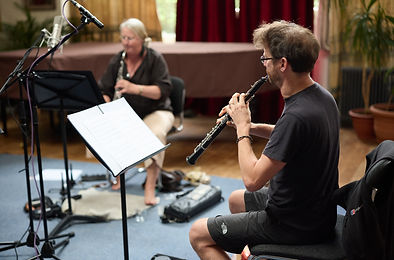
The Lonarc Trio “Captivate,” at The Craxton Studios.
David Hollingum of The Craxton Studios and oboist.
It is a daily routine at The Craxton Studios to hear either recitals, rehearsals, chamber concerts, auditions, TV interviews, filming of movie scenes, or magazine adverts and recordings of instrumental chamber works.
There are moments in music, when artistry, atmosphere and acoustics align perfectly, and this delightful recording session with the Lonarc Oboe Trio was one such occasion.
The Craxton Studios are of course a real home to the oboe as these are the very walls that heard the dulcet tones of one of the “British Greats” of the 20th Century: Janet Craxton, principal at Covent Garden, St Martin -in-the-Fields, London Sinfonietta, soloist and Professor of Oboe at the Royal Academy of Music until she unexpectedly died in 1981.
Much of the post-war British oboe repertoire was commissioned by Janet, some of which was written by her first husband, pianist /composer Alan Richardson.
From the first notes of the first session it was clear that this was more than just a routine day at the studios. The Trio came with a clear vision to capture their interpretation of the two late 18th century oboe trios of Beethoven and a new commission by Edwin Roxburgh alongside his 1984 ‘Shadow-Play’.
I always feel it is important to ensure our recording musicians feel relaxed by providing a “home from home” atmosphere and the sight of familiar faces when they arrived, made this an easy task for me. The musicians Judy Proctor, Joe Saunders and Owen Dennis, filled the studios with warmth and professionalism that radiated in their creative energy. You could sense years of experience at work. How lucky they were to have such an expert sound engineer in Michael Whight who kept a close check on the players’ performance in every take.
I learned a lot about ensemble balance, precision and knife-edge articulation. Double reed players of course understand the intimate demands of blending within a small ensemble, particularly in works where the colour and texture of each line must be carefully sculpted.
It is no easy task to record music of this subtlety and emotional scope but thanks to the wooden cladded Studios’s calm atmosphere, the result promised to be something special.
Edwin Roxburgh had intended to be present on the last day of the recordings but at the last minute was unable to attend. No doubt he knew that he could rely on the artistic integrity if these musicians. I observed their non-verbal communication and intuitive ability to shape the music with a collective soul in the two Beethoven works and the ensemble sound balance in the two Roxburgh works.
The chats and reminiscent laughs we all had in between takes, added to the overall relaxed atmosphere they were working in, and I believe enhanced the final results. I was in no doubt that this was an historic occasion in the making and of great importance to the oboe world for many years to come.
For the double reed community this is a Trio to watch and to hear.


